Over the past 2–3 months, the tone around AI has shifted. What was once pure optimism is now mixed with warnings from investors, CEOs, and regulators.
So… are we in an AI bubble?
Why People Think There is a Bubble
1. Sky-high valuations & fragile sentiment
-
- Nvidia briefly reached nearly $5 trillion in valuation, demonstrating extreme concentration of “AI” bets.
-
- Some AI-heavy stocks saw sharp pull-backs typical of overheated markets.
2. Central banks & institutions sounding alarms
-
- Bank of England warned that AI-focus valuations look “overstretched.”
-
- World Economic Forum cited AI as one of three major global bubble risks.
3. Flood of capital chasing weak ideas
-
- Roughly half of global VC in 2025 went into AI-themed deals.
-
- Many startups are little more than “AI wrapped” versions of old ideas thin moats, thin metrics.
4. Feedback loop among the big players
-
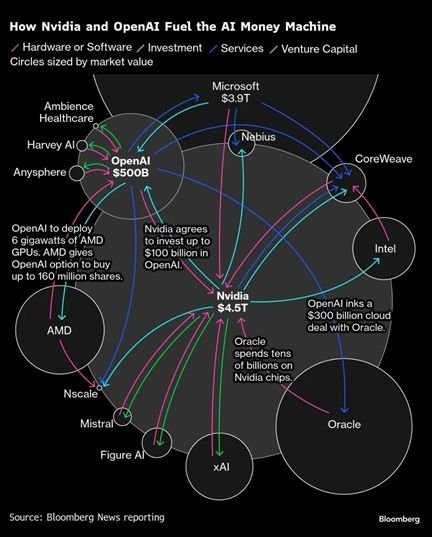
- Microsoft invests billions into OpenAI; OpenAI spends huge amounts on Nvidia GPUs; Oracle and cloud providers supply capacity; Nvidia’s valuation rises.
-
- This circular flow of money, spend and valuation amplifies bubble-like dynamic.
Why It’s Not Just a Bubble
1. Real adoption & real workflows
-
- Over 75% of companies now use AI in core business operations (coding, customer service, analytics), this isn’t just hype anymore.
-
- Demand for infrastructure, chips and compute is tangible.
2. Massive capex focusing on infrastructure
-
- Big technology firms are committing tens of billions of dollars to AI data centres, custom chips, and model training.
-
- This suggests structural change not just speculative frenzy.
3. Early signs of discipline returning
-
- Some corners of the AI market (e.g., AI-biotech, generic copilots) are already seeing funding pull-backs, signalling a maturing phase.
The Nvidia-Microsoft-OpenAI-Oracle Feedback Loop
-
- Microsoft → OpenAI: Microsoft invests heavily into OpenAI and integrates OpenAI’s models into Azure and its productivity suites.
-
- OpenAI → Nvidia & Cloud Providers: To train large models, OpenAI buys massive Nvidia GPU capacity, often hosted on Azure and other clouds (including Oracle Cloud).
-
- Microsoft → Nvidia: Microsoft buys GPU capacity (and sometimes even ahead of demand) from Nvidia to support both its own AI offerings and OpenAI’s workloads.
-
- Oracle / Cloud providers → Nvidia & OpenAI: Oracle purchases GPUs, rents out compute capacity to model-trainers, and benefits when demand for large models grows.
Result: A self-reinforcing loop where each dollar spent by one company drives revenue and valuation of the others, leading to hyper-growth sentiment but also heightened risk.
So… Are We in a Bubble?
Short version: We’re in a real AI super-cycle with pockets of bubble behavior.
-
- The underlying technology wave (AI fundamentally changing workflows, coding, analytics, automation) is real, durable and likely to reshape industries.
-
- But the market behaviour around AI valuations, hype, speculative capital, concentration of risk shows classic bubble signs.
Think of it like the late 1990s: the internet was absolutely transformative, but some companies were priced as if they would instantly dominate every market. Many didn’t.
Many analysts compare today’s AI surge to the dot-com bubble — not because AI isn’t real, but because the market behavior feels similar.

In the late 1990s, the internet was genuinely transformative, yet valuations ran far ahead of revenue, weak startups raised huge capital, and investors treated every .com company as the next big thing. When the bubble burst, the hype collapsed — but the real winners (Google, Amazon, eBay) became trillion-dollar giants. AI is following the same pattern: the technology is real, but not every company riding the wave will survive.
Where the Bubble Risk Is Highest
These are the zones where the bubble behavior is most acute:
-
- Over-concentrated bets in one vendor (e.g., GPU supplier)
-
- Late-stage AI companies with sky-high valuations but weak metrics
-
- “AI-for-X” startups that do little more than wrap an existing model in a niche UI without defensible moats
-
- Any AI + token or speculative “AI coin/funding” play
Final Verdict
AI is not a purely speculative bubble.
Yes there are clear bubble-dynamics, but they exist inside a broader, real mega-trend.
The winners over the next decade will be those who:
-
- Deliver measurable output (productivity, revenue, cost savings)
-
- Serve real customers with retention and proven economics
-
- Own real advantages (data, domain, workflows, brand)
-
- Go beyond “we used AI” to “we solve this critical problem with AI”